Unlocking Your Data with an API for Data Extraction

Think of a data-extraction API as your own personal data entry specialist—one that works 24/7, never makes typos, and can read thousands of documents in the time it takes you to drink your morning coffee. It’s a digital bridge that connects messy, real-world documents (like a PDF invoice or a photo of a receipt) to your software, turning unstructured chaos into clean, organized data.
This isn't just about saving a few minutes here and there. It's about eliminating the soul-crushing task of manual data entry, a process notorious for being slow, expensive, and a breeding ground for human error.
What Exactly Is an API for Data Extraction?
Imagine your accounts payable team gets hit with hundreds of invoices every single month. Each one comes from a different supplier with its own unique layout. The invoice number is in the top right on one, the bottom left on another. The due date is formatted as "MM/DD/YYYY" here and "Day, Month Year" there.
Without an API, someone has to physically (or digitally) open every single file, hunt for those key pieces of information, and painstakingly type them into your accounting system. It’s a recipe for mistakes that can lead to late payment fees, damaged supplier relationships, and completely skewed financial reporting.
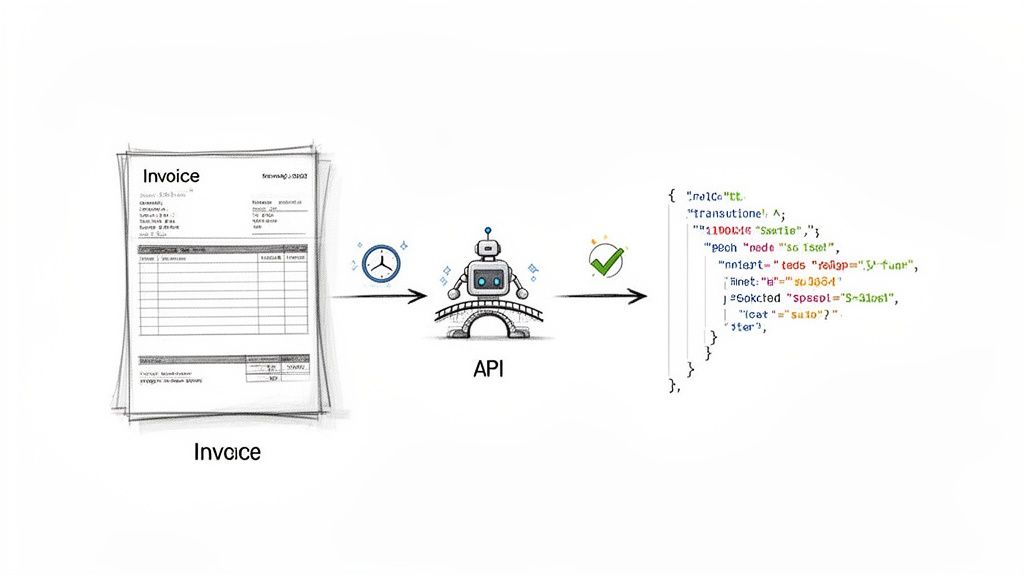
A data extraction API automates that entire workflow. You send it a document, and it acts like a highly trained assistant who instantly knows what to look for. It doesn't just see pixels and text; it understands context. The API recognizes that the text next to "Total Due" is the final amount and that "INV-12345" is the invoice ID, no matter where they are on the page.
From Messy Files to Organized Data
The core job of this technology is to take those jumbled documents and translate them into perfectly structured data that your applications can understand immediately. The most common format for this is JSON (JavaScript Object Notation), which is lightweight, human-readable, and incredibly easy for developers to work with.
This single transformation—from a messy PDF to a clean JSON object—is what makes these APIs so powerful. It closes the gap between the chaotic world of paper and digital files and the orderly world of your databases. For modern businesses, this isn't a luxury; it's a necessity.
Here’s why it’s become such a big deal:
- It frees up your team. No more mind-numbing data entry means your staff can focus on higher-value work like analysis and strategy.
- It kills human error. Automated systems don't get tired or distracted. They achieve an accuracy rate that’s nearly impossible for humans to sustain.
- It moves at machine speed. What takes a person several minutes to process, an API can handle in a matter of seconds.
- It scales with you. You can go from processing 100 documents a month to 100,000 without hiring a single new person for data entry.
A data extraction API isn't just a technical tool; it's a practical solution to a universal business problem: turning raw information into usable intelligence. It automates the grunt work so your team can focus on making decisions, not typing.
It creates a seamless pipeline from your documents straight into your business systems. To dive deeper into the mechanics of how this works, check out our guide on what data parsing is. The end result is a faster, more accurate, and more scalable operation powered by smart automation.
How AI Changes Everything in Data Extraction
To really get why a modern data extraction API is such a big deal, you have to look at how we used to do it. For years, the best tools we had were basic Optical Character Recognition (OCR) and rigid, template-based systems. They sort of worked, but only if everything was perfect.
Think of a template system like a physical stencil you lay over a piece of paper. You create a unique stencil for every single supplier invoice, telling the software exactly where to find the "Total Amount" or "Invoice Number." This is great until a supplier tweaks their invoice design. The second the layout changes, the stencil doesn't fit anymore, and the whole automation grinds to a halt.
This constant breakage made it impossible to scale and meant someone was always stuck doing frustrating maintenance. This is where AI completely rewrites the rules.
From Just Reading to Actually Understanding
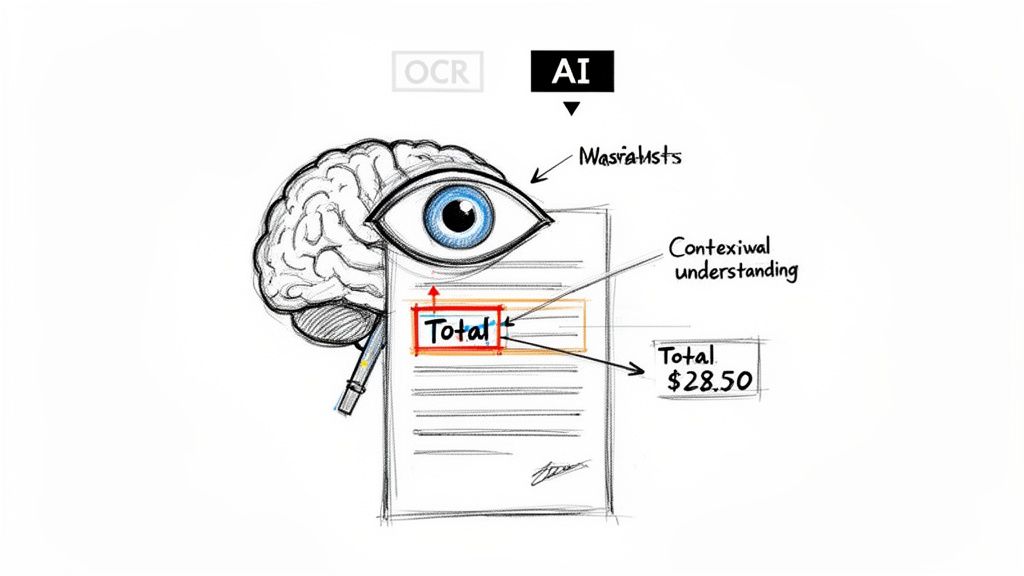
Modern APIs use advanced AI and machine learning models that don't just "read" text; they understand what it means in context. Instead of looking for a field in a fixed location, an AI model learns what an invoice number looks like and how it relates to everything else on the page.
It knows the number next to the word "Total" is the final amount, no matter if it's at the bottom right, top left, or buried deep inside a table. This contextual awareness is the massive leap from a fragile template to a truly intelligent system. It's what lets a single API process documents from thousands of different vendors without needing a custom stencil for each one.
This shift is creating a huge opportunity. The AI API market is expected to rocket from USD 60.59 billion to an incredible USD 884.5 billion by 2034, fueled by this exact demand for flexible, accurate automation. With global data projected to hit 181 zettabytes by 2025—and 90% of it unstructured—AI is the only practical way to handle this flood of documents. You can dive deeper into these trends in this comprehensive AI API market outlook.
An AI-powered API for data extraction doesn't memorize layouts; it learns concepts. This allows it to adapt to endless variations in document structure, delivering consistent and reliable results every time.
To show the clear difference, let's compare the two approaches side-by-side.
Comparing Data Extraction Technologies
This table breaks down how traditional template-based methods stack up against modern AI-driven solutions.
| Feature | Template-Based Extraction | AI-Driven Extraction |
|---|---|---|
| Setup | Requires creating a unique template for each document layout. Time-consuming. | No templates needed. Works "out of the box" with new layouts. |
| Maintenance | High. Templates break whenever a document layout changes, requiring constant updates. | Low to none. The AI adapts to variations automatically. |
| Scalability | Poor. Adding a new document source requires manual setup and coding. | Excellent. Can process documents from thousands of sources with a single model. |
| Accuracy | High on known templates, but 0% when a layout changes. Very brittle. | Consistently high across both known and unknown document formats. |
| Flexibility | Low. Struggles with semi-structured or unstructured documents. | High. Excels at handling variations, messy scans, and complex data. |
| Cost | High initial setup and ongoing maintenance costs. | Typically pay-per-use, with minimal upfront investment and lower total cost of ownership. |
As you can see, the AI-driven approach offers a far more robust and scalable solution for any business dealing with a variety of documents.
The Practical Payoff of AI-Driven Extraction
This intelligent approach leads directly to real, tangible benefits, especially for teams in finance and operations. With AI, an extraction API can tackle complex jobs that were simply too unreliable to automate before. You can learn more in our detailed guide on automated invoice data extraction.
These advanced capabilities include:
- Accurate Line-Item Extraction: AI can identify and pull out individual line items from a table—including descriptions, quantities, unit prices, and totals—even when the table format changes from one document to the next.
- Complex Table Parsing: It can make sense of tricky layouts, like tables that span multiple pages or documents with nested data structures, and correctly link all the related information.
- Superior Flexibility: The system just works. It can handle new document layouts from day one without anyone needing to step in and configure new templates, keeping your operations running smoothly.
Must-Have Features of a Powerful Extraction API
Picking a data extraction API can feel like a shot in the dark, but it doesn't have to be. A few mission-critical features separate the genuinely powerful tools from the ones that just get by. The best APIs go way beyond simple text recognition—they deliver a complete, reliable, and fast solution that plugs right into your automated workflows.
First, check for versatile document support. Your API absolutely must handle common file types like PDFs, JPGs, and PNGs. Why? Because invoices and receipts rarely arrive in a neat, predictable format. This flexibility means you can build one clean process instead of juggling different tools for different files.
Once you’ve confirmed that, the real test begins: how well does it handle the messy, complex data inside those documents?
Advanced Data Recognition Capabilities
The heart of any invoice or bill of lading is the itemized breakdown. This is where a top-tier API really earns its keep. You need an API that delivers:
- Accurate Line-Item Extraction: It must be able to precisely grab every single line item from a table—think descriptions, quantities, unit prices, and subtotals. This is non-negotiable for accurate bookkeeping or inventory management.
- Complex Table Parsing: In the real world, tables get messy. They have nested rows or stretch across multiple pages. A superior API can intelligently piece these complex structures together, connecting all the related data without you having to step in.
A truly smart data extraction API doesn’t just see a table; it understands the relationships within it. That’s the magic that turns a jumble of text into clean, structured, and usable data.
Automation and Performance Metrics
A great API isn't just accurate; it’s fast and built for automation. Slow processing or a clunky integration can create bottlenecks that completely defeat the purpose of automating in the first place. You need features that enable a smooth, real-time workflow.
The global market for these tools is on track to hit USD 2.5 billion, largely because companies are desperate to escape manual data entry, which costs an average of $12 per invoice. The right API can slash that cost by an incredible 92%, but only if it’s built for modern automation. You can find more details in these data extraction market trends.
Here are the automation and performance features to look for:
- Webhooks for Real-Time Processing: Instead of constantly asking the API, "Are you done yet?" a webhook system automatically pushes the results to your application the second they’re ready. This is the foundation of a true "set-it-and-forget-it" workflow.
- Efficient Batch Processing: Got thousands of documents to process? A scalable API should handle large batches in parallel, not stick them in a slow-moving queue.
- Sub-5-Second Speed: In today’s world, speed is everything. Look for an API that returns structured data in under five seconds to keep your operations running smoothly.
- Proven Accuracy Above 99%: The provider should be upfront about their accuracy rates. For standard documents, anything less than exceptional isn't good enough.
By focusing on these features, you’ll find a data extraction API that isn't just another tool, but a genuine asset for scaling your business. If you want to dig deeper, check out our complete guide on what to look for in a data extraction API.
Integrating a Data Extraction API Into Your Workflow
Theory is great, but putting a data extraction API into practice is where you see the real payoff. Getting one wired into your existing applications is often much simpler than you might think, especially with modern RESTful APIs built for a smooth developer experience.
The process really just boils down to a few straightforward steps that can turn a tedious manual task into a fully automated workflow.
At its core, the most direct way to integrate is by making a simple API call. You authenticate with an API key, send over a document (like a PDF or JPG), and in return, you get clean, structured data—usually in JSON format. This basic request-response model is the foundation for countless integrations.
This visual breaks down the essential journey of a document through an extraction API, from the initial upload to receiving accurate, structured data.
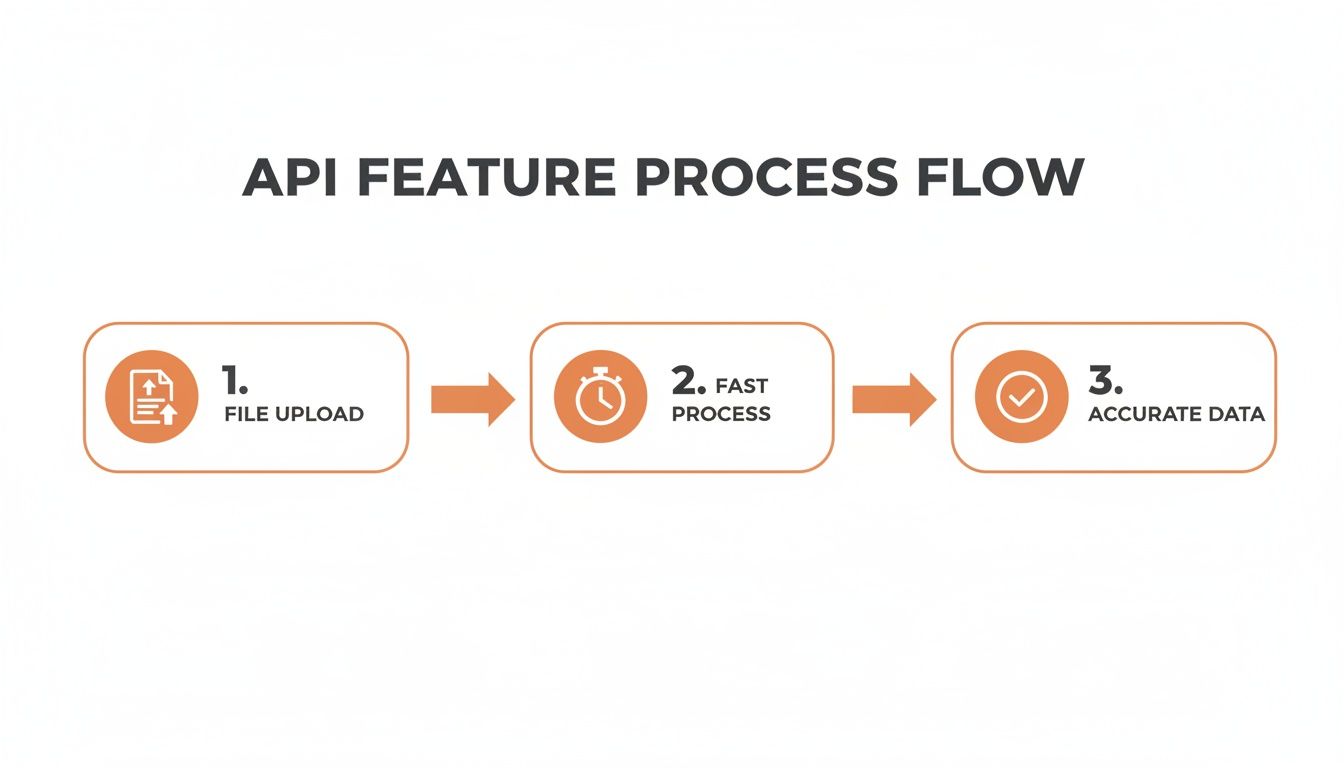
It highlights what a modern API should deliver: simplicity, high-speed processing, and dependable accuracy.
Building a Truly Automated System with Webhooks
While direct API calls are useful, the key to "set-it-and-forget-it" automation is using webhooks. Think of webhooks as a notification system for your software. Instead of your app constantly having to poll the API and ask, "Is that document done yet?" the API proactively sends the structured data to your system the instant it's ready.
This event-driven approach is far more efficient and scalable. Here’s how a typical flow works in a real business scenario:
- Trigger: An invoice arrives as an email attachment and is automatically saved to a specific cloud storage folder.
- API Call: A script notices the new file and immediately sends it to the data extraction API for processing.
- Webhook Notification: Once the API finishes extracting the data (usually in seconds), it automatically sends the structured JSON payload to a pre-configured URL endpoint in your application.
- Workflow Automation: Your app receives the data and instantly creates a new bill in your accounting software, logs the expense, and archives the original document. No human intervention needed.
Webhooks are the secret to unlocking seamless, end-to-end automation. They eliminate the need for anyone to touch the process after the initial upload, connecting your document source directly to your business systems in real-time.
The Power of a Great Developer Experience
The final piece of a smooth integration is the quality of the tools your development team gets to work with. A well-designed API always prioritizes the developer experience, which translates directly to faster implementation and lower maintenance costs for your business.
So, what should you look for in a provider?
- Clear and Comprehensive Documentation: Easy-to-follow guides with code examples in multiple languages (like Python, cURL, or JavaScript) are non-negotiable.
- Simple Authentication: A straightforward API key system gets you up and running without unnecessary hoops to jump through.
- A Sandbox for Testing: A safe environment where you can test the API with your own documents without burning through your budget is invaluable during development.
A strong developer experience means your team can go from a concept to a fully functional, automated workflow in a matter of hours, not weeks. For a practical example of clear instructions, you can explore our own getting started documentation, which walks you through your first API call step-by-step.
How to Choose the Right Data Extraction API
Picking a data extraction API isn't just about grabbing the first one you find. It's a strategic decision that directly affects your team's efficiency, the security of your data, and how well your systems can grow. With so many options out there, you need a solid game plan to find a real partner, not just another vendor.
The first thing to look at is accuracy and reliability. Every provider will boast about their accuracy rates, but the proof is in the pudding. Don't fall for demos using perfectly clean, sample documents. You need to test them with the kind of messy, real-world files your team deals with every day—blurry scans, weird layouts, and all. A truly reliable API delivers the right data, consistently.
After you've vetted for accuracy, it's time to see how the API holds up under pressure. That's where scalability and security come in.
Evaluating Scalability and Security
Scalability means more than just handling a higher volume of documents. It's about maintaining that performance when you need it most. Can the API chew through thousands of documents at once without choking? Does its response time crawl to a halt during your peak business hours? A genuinely scalable API should handle sudden spikes without breaking a sweat, ensuring your workflows never grind to a halt.
Security is just as critical, if not more so. You're handing over sensitive financial and customer data, and there's simply no room for error. Make sure any provider you consider has its security fundamentals locked down:
- End-to-end encryption with TLS/SSL is non-negotiable for protecting data in transit.
- Compliance with data privacy regulations like GDPR is a must-have.
- Strict data retention policies should be in place, ideally deleting your files immediately after they’re processed.
The data extraction market is exploding, now valued at a staggering USD 4.8 billion, which tells you how critical these tools have become. With regulations like GDPR forcing 78% of enterprises to rethink their data handling, a secure and compliant API isn't a "nice-to-have"—it's essential. These tools can slash manual data entry by 90%, giving precious hours back to your team. You can dive deeper into these data extraction market trends and analysis to see where the industry is heading.
Understanding Pricing and Developer Experience
Don't let confusing pricing models trip you up. To find the true cost, you have to look past the sticker price. Some vendors will try to lock you into expensive annual contracts, while others offer more flexible pay-as-you-go plans. A usage-based model, like the one we offer at ExtractBill, often makes more sense because your costs scale directly with your needs, without the long-term commitment.
Finally, and this is a big one, never underestimate the developer experience. A powerful API with messy documentation is just a headache waiting to happen.
The best API is one your developers can implement quickly and maintain easily. A great developer experience is a direct indicator of a well-designed, reliable product.
Look for a provider that makes integration a breeze. Here’s what that looks like:
- Clear, comprehensive documentation with code examples in the languages your team actually uses.
- A free sandbox environment so you can test the API with your own documents before you commit.
- Responsive and knowledgeable support from people who can actually help you solve problems fast.
By measuring every potential provider against these key pillars—accuracy, scalability, security, pricing, and developer experience—you can confidently pick a data extraction API that solves today's problems and grows with you tomorrow.
Got Questions? We’ve Got Answers
Thinking about using a data extraction API is a smart move, but it's natural to have a few questions before you dive in. Let's tackle the most common ones we hear from developers and product managers.
How Hard Is It to Actually Integrate One of These APIs?
Honestly, it's probably easier than you think. Modern, developer-first APIs are built to get you from zero to a working proof-of-concept in minutes.
The whole process usually boils down to a single REST API call. You send the document along with your secure API key, and that's it. Most good providers will have excellent documentation packed with copy-paste code snippets for languages like Python, JavaScript, or whatever your team uses. Need more advanced automation? Setting up a webhook is often just pasting a URL into your account dashboard. If you've worked with any API before, you can have a functional integration up and running in less than an hour.
What Kind of Accuracy Should I Realistically Expect?
For standard documents like invoices and receipts, the best AI-powered APIs are consistently hitting above 99% accuracy. This isn't just basic text recognition; the AI models today are smart enough to understand context. They know what a "Total Due" field is, no matter where it shows up on the page.
That said, nothing is perfect. Accuracy can dip if you're dealing with really poor-quality scans, crumpled paper, or super unusual layouts. Messy handwriting can also be a challenge for any system.
The only way to know for sure is to test it with your documents. A good service will give you a free trial. Use it to run a few of your own real-world examples through the system before you commit to anything.
Is It Safe to Send Our Financial Data to a Third-Party API?
Absolutely, provided you pick a reputable provider who takes security seriously. The leading data extraction APIs are built from the ground up with robust security controls to protect your sensitive information.
Here’s what you should look for as a bare minimum:
- End-to-end TLS/SSL encryption to protect data as it travels over the internet.
- Secure API key authentication, so only your application can make requests.
- Compliance with data privacy laws like GDPR.
- Clear data retention policies, ideally where your documents are deleted right after processing.
Always take a few minutes to read through a provider’s security and privacy docs. It’s your due diligence, and it’s critical for keeping your data—and your customers' trust—safe.
What’s the Difference Between OCR and a Data Extraction API?
This is a fantastic question and a really important distinction. Think of it this way: Optical Character Recognition (OCR) is just the first step. Its only job is to look at an image and convert the pixels into a raw block of text. It's like turning a picture of a book into a plain .txt file—you get the words, but none of the structure.
A data extraction API does so much more. It starts with OCR to read the document, but then it layers on an advanced AI model to actually understand what it's reading. This AI is what identifies key-value pairs ('Invoice Number': 'INV-123'), pulls out all the line items from a table, and neatly organizes everything into a structured JSON file that your software can actually use.
In short, OCR gives you text. A data extraction API gives you intelligent, structured data you can build with.
Ready to stop typing and start automating? With ExtractBill, you can turn messy documents into clean, structured JSON in seconds. Our AI-powered API delivers 99.9% accuracy with a dead-simple, pay-as-you-go model. Try it for free at ExtractBill.
Ready to automate your documents?
Start extracting invoice data in seconds with ExtractBill's AI-powered API.
Get Started for Free