Accounts payable automation benefits: Boost Efficiency and Cut Costs
The real benefits of accounts payable automation are simple and direct: you slash invoice processing costs, kill manual errors, and get vendors paid much faster. This isn’t just an upgrade; it’s a strategic shift that transforms your AP department from a back-office cost center into an efficient, data-driven financial engine.
Moving Beyond Manual Invoice Processing
Let's be honest—the traditional accounts payable department is often buried under a mountain of paper. The daily grind is a familiar story of mind-numbing data entry, chasing approvals through endless email chains, and dealing with the inevitable lost or misplaced invoice. This picture isn't just inefficient; it's incredibly expensive.
Think of manual AP like a leaky bucket. Every single drop is a hidden cost that goes far beyond employee salaries. These leaks are the true price you pay for an outdated process.
The Hidden Costs of Old-School AP
The financial drain from manual processing is almost always bigger than businesses realize. It’s not just about paying someone to type in numbers; it's the compounding effect of all the small inefficiencies that really hurts.
The most painful hidden costs usually fall into three buckets:
- Late-Payment Penalties: When invoices get stuck in someone's inbox or are simply lost in a pile of paper, you miss payment deadlines. Those late fees go straight to your bottom line as pure, unnecessary loss.
- Missed Early-Payment Discounts: Many suppliers offer a 1-2% discount for paying early. A manual system is almost always too slow and chaotic to consistently capture these opportunities, which means you're leaving free money on the table every single month.
- The High Price of Human Error: It only takes one typo during data entry to cause an overpayment, a duplicate payment, or throw off your financial reporting. Finding and fixing these mistakes eats up even more time and resources.
The reality is that manual invoice processing isn't just slow—it's a strategic liability. It actively prevents your finance team from focusing on high-value work like cash flow analysis, forecasting, and vendor negotiations.
This is where AP automation proves its worth. It’s not just another piece of software; it's a fundamental change designed to plug all those leaks. By automating the repetitive, error-prone tasks, you directly solve these pain points.
For a deeper look into this process, you can learn more about how to automate invoice processing and reclaim your team’s valuable time. This shift is the first step to unlocking the significant financial and operational gains that modern AP systems deliver.
Capturing Direct Financial Wins with Automation
While faster operations are a huge perk, the real story behind AP automation is written in dollars and cents. Shifting away from manual processes is about more than just efficiency; it’s about fundamentally changing your AP department's financial impact. You’re turning a classic cost center into a source of tangible, measurable value.
The financial upside is direct and often much bigger than people expect, starting with the single biggest expense in a traditional AP workflow: the cost to process just one invoice.
Dramatically Lower Your Cost Per Invoice
Handling an invoice by hand is shockingly expensive. Think about it: mail sorting, manual data entry, routing it for approvals, and finally, cutting a check. Every single step adds labor costs and opens the door for human error. This is where automation delivers its first, and arguably most powerful, financial win.
Imagine slashing your invoice processing costs from $12-18 down to just $2-4 per invoice. That’s the kind of impact we’re talking about. For businesses drowning in paper, this isn't just a nice-to-have saving; it's a complete game-changer.
Traditionally, AP teams burn a shocking 30% of their time just on tedious data entry. With automation, that number plummets to a mere 5%, freeing up your team for work that actually requires a human brain. The secret is eliminating those time-sucking manual steps, creating a nearly "touchless" workflow powered by smart tools. You can get a closer look at the tech behind this in our guide to invoice data capture software.
To put the financial gains in perspective, let's compare the two approaches side-by-side.
Manual AP vs Automated AP: A Financial Comparison
This table breaks down the key financial metrics, showing just how stark the difference is between a traditional AP process and an automated one.
| Metric | Manual AP Process | Automated AP Process | Financial Impact |
|---|---|---|---|
| Cost Per Invoice | $12 - $18 | $2 - $4 | ~80% cost reduction per invoice processed. |
| Early Payment Discounts | Rarely captured | Consistently captured | Unlocks a new revenue stream (1-2% of spend). |
| Late Payment Fees | Common occurrence | Virtually eliminated | Avoids unnecessary penalties and protects vendor relationships. |
| Error & Fraud Risk | High (duplicate payments, typos) | Low (automated validation) | Prevents costly overpayments and strengthens internal controls. |
| Cash Flow Visibility | Delayed and fragmented | Real-time and centralized | Enables strategic cash management and accurate forecasting. |
As you can see, the numbers don't lie. Automation doesn't just chip away at costs—it fundamentally restructures the financial performance of your accounts payable function.
Turn Your AP Department into a Profit Center
Beyond slashing direct costs, automation unlocks revenue streams that are almost impossible to tap into with manual processes. The big one? Systematically capturing early payment discounts.
Many suppliers offer a 1-2% discount for paying an invoice within 10 days instead of the usual 30. On its own, 2% doesn't sound like much. But when you apply that across all your vendor spend for an entire year, it adds up to a serious amount of cash.
An automated system gives you the speed and visibility to consistently hit those discount windows. When you can process an invoice in a few hours instead of a few weeks, your payables suddenly become a reliable source of savings.
This completely flips the script on the AP department. It’s no longer just a bill-paying function; it’s an active contributor to the company’s bottom line.
This chart really drives home how much money gets silently drained away by a manual process.
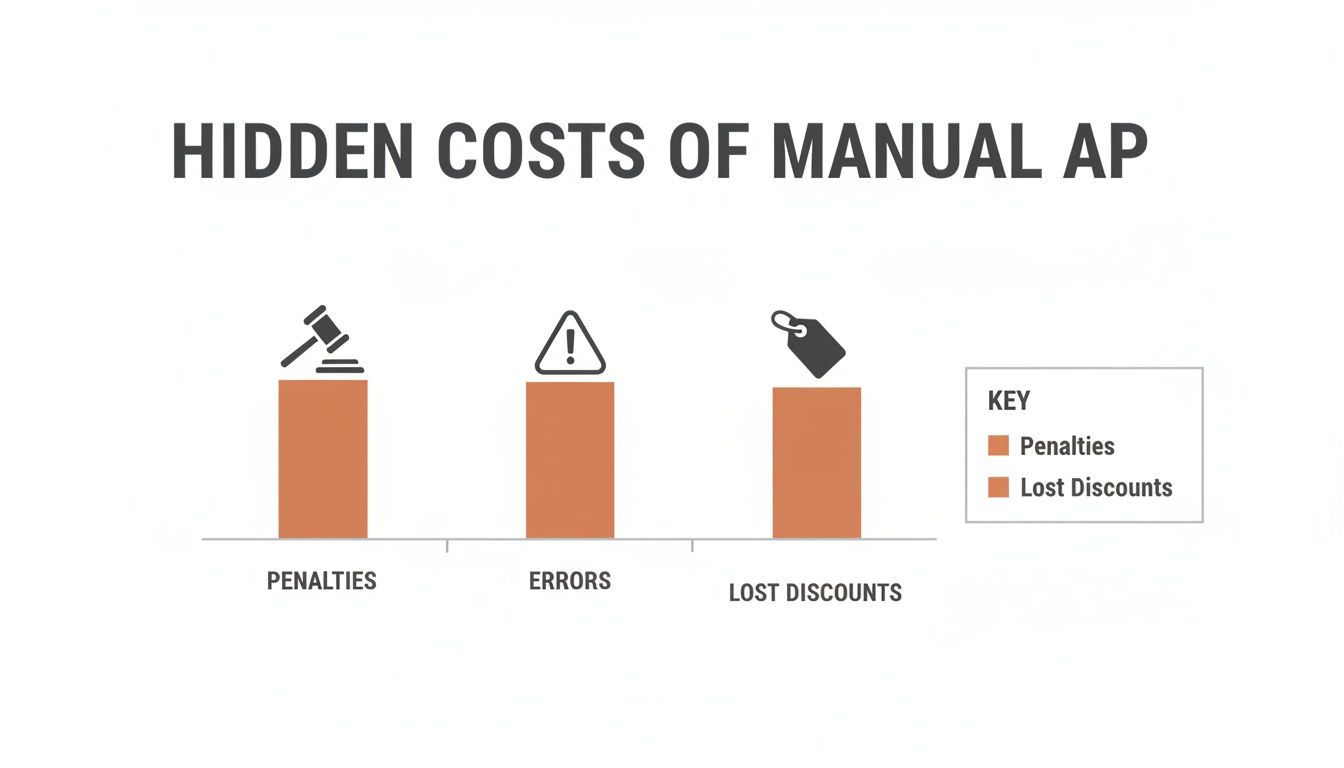
As you can see, it's the combination of late fees, costly errors, and missed discounts that creates a significant financial drag—one that automation is perfectly designed to fix.
Gain Superior Cash Flow Management
Finally, one of the most powerful financial benefits of AP automation is gaining true command over your cash flow. Manual systems give you a blurry, delayed snapshot of your liabilities, making it incredibly difficult to forecast what you'll need and when. You’re essentially flying blind, reacting to bills as they pile up.
Automation changes all that by giving you a real-time, centralized dashboard of every outstanding invoice and its due date. This clarity is a superpower, empowering you to:
- Forecast with Accuracy: Know exactly what you owe and when, leading to precise cash flow projections.
- Optimize Payment Timing: You can decide to hold onto cash until the last possible second or pay early to grab a discount, all based on a clear view of your financial standing.
- Make Smarter Decisions: Use data, not guesswork, to manage working capital, negotiate better terms with vendors, and make strategic financial moves with confidence.
This level of control means you’re never caught off guard by a payment run again. You’re always in the driver's seat, putting your capital to its best and highest use.
Boosting Operational Speed and Accuracy
Forget the financial wins for a moment. One of the first things you'll notice with AP automation is a massive upgrade to your operational engine.
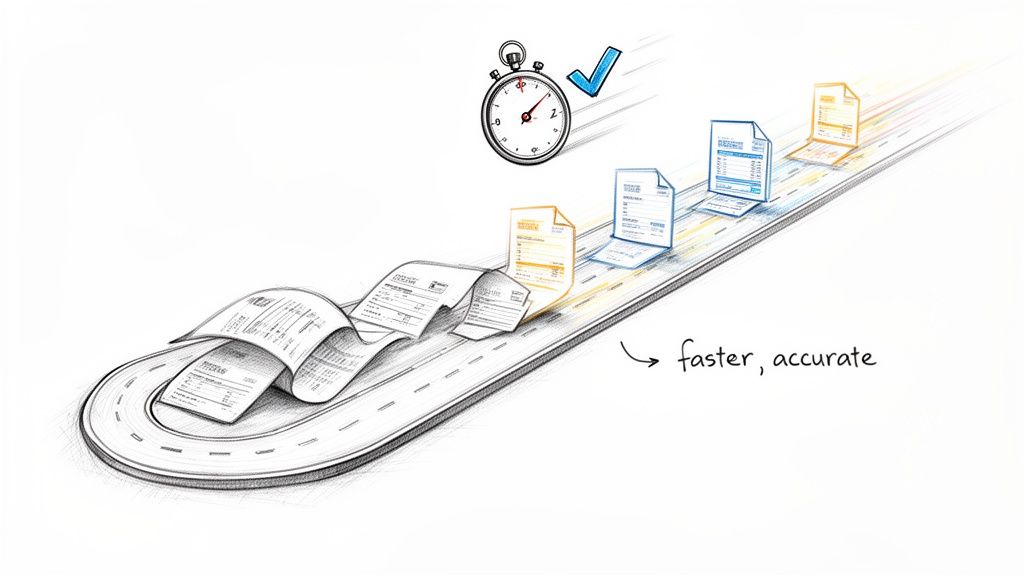
Think of your manual invoice process like a winding country road—full of potholes, unexpected stops, and traffic jams. Automation rips that up and lays down a multi-lane expressway. Information just flows.
This isn't just about moving a little faster. It's about systematically bulldozing the bottlenecks that have plagued AP departments for decades. Things like printing invoices, physically walking them over to a manager's desk, and chasing approvals with endless follow-up emails simply evaporate. The entire procure-to-pay cycle shrinks from weeks down to a matter of days, sometimes even hours.
Eradicating Human Error with Intelligent Data Capture
Let's be honest: the single biggest source of slowdowns and expensive mistakes in a manual AP process is data entry. One tiny typo can cascade into an overpayment, a duplicate invoice, or completely skewed financial reports. These aren't just minor inconveniences; they erode supplier trust and force your team into hours of tedious detective work.
This is where AI-driven tools completely change the game. Technologies like Optical Character Recognition (OCR) and advanced data extraction services act as a digital bouncer, making sure only clean, validated data gets into your system.
By automating data entry, businesses can hit accuracy rates that top 99%. This nearly wipes out the risk of common human errors, saving you time and money while ensuring your financial data is rock-solid.
Instead of someone squinting at a PDF and punching numbers into a spreadsheet, an automated system reads, understands, and structures the invoice data in seconds. That level of precision is the bedrock of an efficient workflow. For a deeper look at how this works, check out our guide on how to extract data from invoices with modern AI.
Building a Scalable Back-Office Operation
This newfound speed and accuracy unlock another critical advantage: scalability. In a manual world, when invoice volume doubles, you have to double your headcount. It’s an expensive, unsustainable model that turns business growth into an operational headache.
Automation shatters that cycle. An automated system can process 1,000 invoices almost as easily as it can process 10. Your business can scale, take on more vendors, and grow revenue without having to proportionally bloat your AP team.
Here’s how that scalability actually plays out:
- Increased Throughput: Your current team can suddenly handle a much higher volume of work without feeling buried. The system does the repetitive heavy lifting.
- Consistent Performance: Manual processing slows down during busy seasons, holidays, or when someone is out sick. An automated workflow, on the other hand, performs predictably and consistently, day in and day out.
- Focus on Strategic Work: Once you free your AP pros from data entry and invoice chasing, they can focus on high-value tasks—like analyzing spending, negotiating better payment terms with suppliers, and tightening financial controls.
How Automation Accelerates the Entire Workflow
To really see the difference, just look at the typical journey of an invoice. The contrast between a manual and an automated system is night and day.
The Old Way: Manual Invoice Journey (15-20 Days)
- Receipt: Invoice arrives by mail or email, gets printed out, and lands in a physical inbox.
- Data Entry: An AP clerk manually keys every line item into the accounting software.
- Approval Routing: The paper invoice is hand-carried from desk to desk for signatures.
- Payment: Once it’s finally approved, someone has to manually schedule and process the payment.
The New Way: Automated Invoice Journey (1-3 Days)
- Capture: An invoice is automatically grabbed from an email or portal and digitized instantly.
- Extraction & Validation: AI extracts all the key data in seconds and validates it against purchase orders or other records.
- Approval Workflow: The digital invoice is instantly sent to the right approver, who can approve it with a single click—even from their phone.
- Payment: Once approved, the payment is automatically scheduled according to your rules.
This radical acceleration doesn't just make life easier for your AP team. It strengthens relationships with your vendors through prompt payments and gives your entire business a far more agile financial backbone.
Of all the benefits of AP automation, this might be the most underrated. Beyond just making things faster and cheaper, automation builds a fortress around your financial operations. If you've ever dreaded an audit, you know the pain of manual processes—paper trails that go cold, scattered email approvals, and a constant, nagging risk of non-compliance.
Think of a manual system like a diary written in pencil. Entries can be smudged, pages can get ripped out, and it’s nearly impossible to prove who wrote what and when. An automated system is the complete opposite. It's more like a permanent, unchangeable digital ledger where every single action is recorded, creating an ironclad audit trail that keeps you compliant and auditors happy.
Creating an Immutable Digital Audit Trail
From the second an invoice hits your automated system, its entire life story is being written. The journey from receipt to final payment is logged, with every step captured, timestamped, and tied to a specific user. This creates a perfect, chronological history of every single transaction.
No more frantic searches through filing cabinets or digging through old email chains. When an auditor asks, "Show me who approved invoice #789 and on what date," you don't have to break a sweat. You can pull up a definitive, documented answer in seconds.
This level of transparency turns audit prep from an all-hands-on-deck fire drill into a routine, low-stress task. Everything an auditor needs is right there—centralized, searchable, and secure.
Enforcing Internal Policies Without Exception
Let’s be honest, one of the biggest headaches with manual AP is getting everyone to follow the rules consistently. A manager in a hurry might approve a purchase over their spending limit, or a payment gets rushed out the door without the proper two-person sign-off. These little slip-ups seem minor, but they open the door to major risks.
Automation acts as your digital gatekeeper, enforcing your company's rules 100% of the time. It programmatically manages your internal controls, making policy violations virtually impossible.
- Approval Hierarchies: Invoices get automatically routed to the right person based on preset rules like department, dollar amount, or project code. No more guesswork.
- Spending Limits: The system can instantly flag or block any invoice that exceeds an approiver’s authorized limit.
- Duplicate Payment Prevention: Automation cross-references every new invoice against your payment history, catching and stopping duplicate payments before they ever happen.
This systematic enforcement dramatically cuts down the risk of unauthorized spending and both internal and external fraud. It turns your compliance policies from a well-meaning guideline into a hard-coded guarantee.
By creating an unchangeable record of every transaction and enforcing internal rules automatically, AP automation turns compliance from a manual burden into a built-in safeguard for your business.
This shift is completely changing how companies think about being "audit-ready." Digital workflows create immutable audit trails that drastically slash external audit costs and agonizing delays. While chasing down manual email approvals often leads to failed internal controls, automation logs every single step, giving you concrete proof that policies were followed. It’s no surprise that top-performing AP teams are 3x more likely to automate their reporting, which has the added benefit of boosting forecasting accuracy. You can discover more insights about top AP automation solutions to see how this trend is playing out.
Ultimately, this is all about control and confidence. You get the peace of mind that comes from knowing your processes are locked down, your policies are being followed without fail, and you are always prepared for financial scrutiny.
Beyond the dollars and cents, one of the most powerful gains from AP automation happens on a human level. Let's be clear: this isn't about replacing people. It's about elevating them.
When you free your AP pros from the monotonous grind of data entry and paper chasing, you're making a direct investment in their job satisfaction and professional growth.
Think about it. In a manual system, your team's most valuable asset—their time—is spent on repetitive, error-prone tasks that are, frankly, unfulfilling. This constant cycle of tedious work is a fast track to burnout and low morale. Automation completely flips that script.
From Clerical Staff to Strategic Analysts
Once you remove the burden of manual invoice processing, you unlock your team's real potential. The time and mental energy they once poured into keying in data and tracking down approvals can now be aimed at high-impact activities—the kind that require critical thinking and strategic insight.
This shift transforms them from clerical staff into genuine financial analysts. Instead of just pushing paper, they start actively contributing to the company's financial health.
This evolution is a genuine competitive advantage. An engaged, analytical finance team can identify cost-saving opportunities, improve vendor relationships, and provide the data-driven insights needed for smarter business decisions. It’s a move from reactive problem-solving to proactive financial strategy.
This change empowers your team to focus on the work that actually matters, creating a more dynamic and forward-thinking finance department.
Unlocking High-Impact Activities
With the right tools, your AP professionals can move beyond the daily grind and focus on tasks that create real, tangible value. This is where their expertise truly shines.
Here are just a few of the strategic activities an empowered AP team can tackle:
- Vendor Negotiations: Armed with clear data on payment histories and spending patterns, your team can negotiate for better terms, pricing, and discounts with key suppliers.
- Spend Analysis: They can dive deep into spending data to spot trends, pinpoint areas of overspending, and find opportunities for cost reduction.
- Cash Flow Optimization: By strategically managing payment schedules, they can help optimize working capital—deciding when to pay early for a discount versus holding onto cash a little longer.
- Process Improvement: Freed from the "how," they can finally focus on the "why." They can analyze the entire procure-to-pay cycle to find and fix hidden inefficiencies.
When you equip your team with modern tools, you're not just buying software; you're investing in your people and their ability to drive the company forward. This boost in morale and capability is one of the most powerful, long-term benefits you’ll get from automating your accounts payable process.
Seeing It in Action with AI-Powered Data Extraction
All the benefits we've talked about—from slashing costs to speeding up approvals—really boil down to one critical first step: getting accurate invoice data into your system. This is precisely where manual processes fall apart and AI-powered tools become the engine for real automation.
If you don't start with clean, structured data, you'll always have a bottleneck. It’s that simple.
Let’s walk through a real-world example. Your company gets an invoice from a supplier, tucked away as a PDF in an email. In the old-school workflow, an AP clerk has to open that file, squint at the details, and painstakingly type everything into the accounting software.
It’s slow, tedious, and a recipe for typos. But with modern automation, this whole mess is sorted in seconds, with zero human intervention.
Transforming Messy PDFs into Structured Data
Instead of someone manually keying in data, an AI-powered service like ExtractBill gets to work the moment that PDF arrives. The invoice is automatically forwarded to a data extraction API, and within seconds, the system doesn't just read the text—it understands it.
It pinpoints key fields with incredible precision:
- Vendor Name: It correctly identifies the supplier, even if the logo is weird or the name is buried in the footer.
- Invoice Number: It grabs the unique ID without confusing it with a PO number or customer code.
- Due Date: It reads and standardizes the date, so your payment scheduling is always on point.
- Line Items: It captures every single item, quantity, and price with near-perfect accuracy.
This diagram shows how a plain document gets turned into clean data your accounting system can actually use.
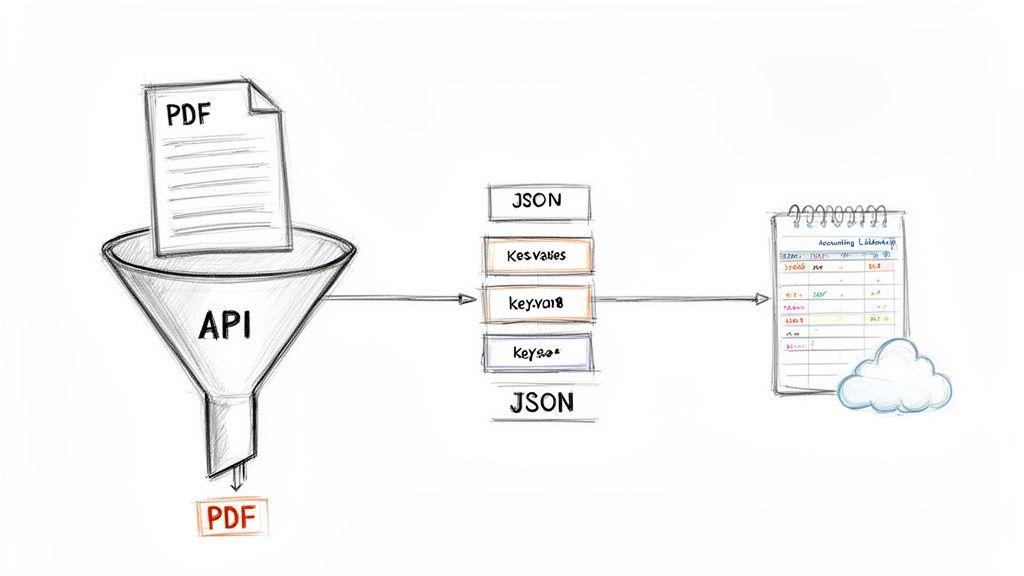
What comes out the other side is a perfectly structured data file (like JSON) that your accounting software can instantly read. This is the bedrock of a 'touchless' workflow.
This seamless flow of data is what makes all the other benefits of AP automation possible. If you're curious about the nuts and bolts, you can dig deeper into how a data extraction API acts as the brain behind this operation.
The Power of 99.9% Accuracy
The data coming from this AI extraction isn't just fast; it's ridiculously accurate. Services like ExtractBill hit 99.9% accuracy, which practically wipes out the costly human errors that plague manual data entry. Think about it: one typo in an invoice amount or due date can cause overpayments, missed discounts, or even tick off a key supplier.
By making sure the data is right from the very beginning, you build a foundation of trust for the entire AP process. That precision means approvals happen faster, payments are always correct, and your financial reports are solid.
At the end of the day, this AI-powered extraction is the essential link connecting a jumbled document to a smooth, automated financial workflow. It’s the invisible but crucial first step that makes every other efficiency gain a reality. It takes the most mind-numbing, error-prone task in the AP cycle and makes it instant, accurate, and completely hands-off.
Got Questions About AP Automation? You're Not Alone.
Even with the obvious wins, switching up a core financial process like accounts payable can feel like a huge undertaking. It’s smart to have questions about how it all works, what it costs, and whether it's truly secure. Let's tackle some of the most common hurdles that keep teams stuck in manual mode.
A lot of business leaders I talk to are worried about a massive, disruptive IT project. The reality is, modern AP automation tools are built to plug in and go—not to cause months of headaches.
How Long Will This Take to Set Up?
Honestly, probably a lot less time than you think. Cloud-based AP systems are designed for speed. We're talking days or weeks, not quarters.
The whole process usually breaks down into a few simple stages:
- System Configuration: This is where you teach the software your rules—who needs to approve what, spending limits, and so on. You’re essentially building your company’s policies directly into the system.
- ERP Integration: The new tool has to talk to your main accounting software. Most modern platforms have pre-built connectors that make this feel more like plugging in a new app than a custom coding project.
- Team Training: Getting your people comfortable. Because these platforms are built to be user-friendly, this is often a quick walkthrough, not a week-long seminar.
The goal is always a fast, smooth switch so you can start seeing the value right away.
Is Our Company's Data Really Secure?
This is a big one, and it should be. You're dealing with sensitive financial data. The top AP automation platforms are built with security at their core, not as an afterthought.
Here's a thought: your data is often far safer locked down in a centralized, encrypted system than it is sitting in filing cabinets or getting passed around in unsecured emails.
These systems use serious security measures—things like advanced encryption, strict access controls, and regular audits—to protect your information from anyone who shouldn't see it. By pulling all your invoice and payment data into one secure place, you’re actually reducing the risk that comes from having paper and digital files scattered everywhere.
When Do We Actually See a Return on This?
This is the best part. The ROI on AP automation isn't some fuzzy, five-year plan. You start seeing it almost immediately, and you can measure it in real dollars.
The financial payoff comes from a few places:
- Lower Labor Costs: This is the most obvious win. You immediately stop paying for hours and hours of manual data entry, paper shuffling, and chasing approvals.
- Early Payment Discounts: Suddenly, capturing those 1-2% discounts for paying early becomes easy. That might not sound like much, but it adds up to serious money over a year.
- No More Late Fees: You stop bleeding cash on penalties that were completely avoidable.
- Catching Costly Errors: Preventing a single duplicate payment or overpayment can often pay for the software for months.
Most companies discover that the savings from these four areas alone cover the cost of the system well within the first year, sometimes in just a couple of months. And from there, the benefits just keep compounding.
Ready to stop the manual data entry grind for good? ExtractBill turns any invoice into clean, structured JSON with 99.9% accuracy in seconds. Try it for free and see how much time you can get back.
Ready to automate your documents?
Start extracting invoice data in seconds with ExtractBill's AI-powered API.
Get Started for Free